
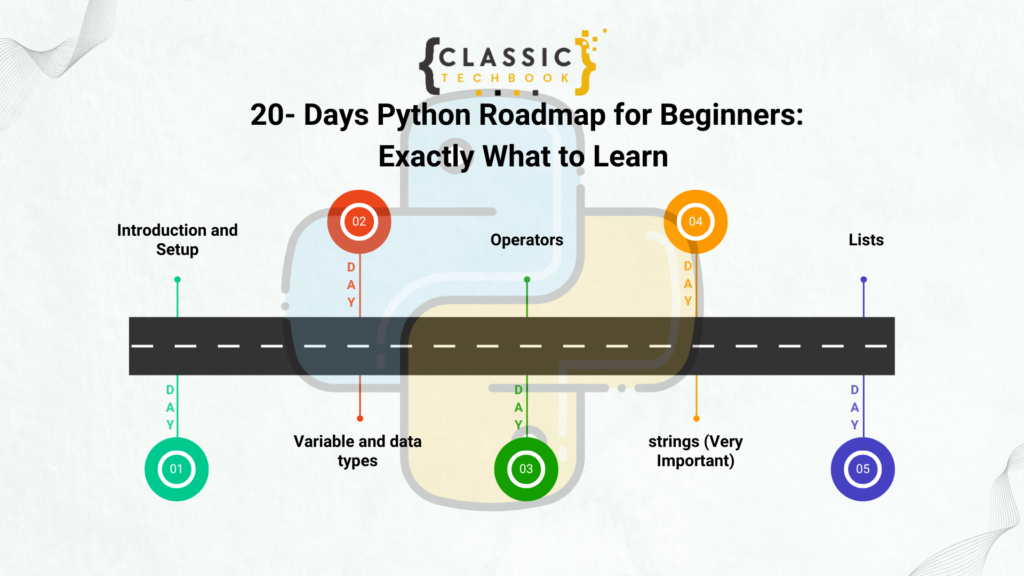
Day 1: Introduction
20 Days Python Roadmap for Beginners is made for students and fresh learners who have zero knowledge of programming. This roadmap explains Python concepts in very simple language and shows where Python is used in real life. By following this 20-day python roadmap plan, beginners can build a strong foundation in Python and move towards real projects with confidence.
What is python?
Python is computer programming language that helps user to give instruction to computer to tell what to do. It is considered as most popular programming language because it is easy to read and understand for beginners. It is HLL (High Level Language).
Where it is used?
python programming is used in different fields such us:
- Making websites using flask library.
- Automation of daily work
- Data analysis and visualization
- Artificial intelligence
- Machine Learning
Install python and jupyter notebook: Python software : It will be installed to make a python environment in your computer
Jupyter notebook: It will be used to write python code in your system
**If you want to learn how to install and setup Python & Jupyter Notebook in your system click here and read this article
Day 2: Variable and Data types
Variables: variables are used to store any Values of different type. Example: 1,d,324
Data types: Data types tell python which kind of data is stored in the variable. Example: Numbers, Text, Yes or no etc.
Type casting: It is method used to change one type of data to another type, like int to text, int to float etc.
Function: Functions are help to use a particular task again and again with Repetition of that code.
Day 3: Operators
What are operators?
these are some symbols which helps to perform to operations like calculation and comparisons. These operators are used in creating logical python program.
Types of Operators: Basically there are 4 types of operators
- Arithmetic: for mathematical operations
- Assignment: For sorting values
- Comparison: For checking conditions
- Logical: for checking different conditions at a time
Day 4: strings (Very Important)
What is String?
It is a text data which is stored in a variable under “ “. Example: Name, message, story etc.
String Indexing and slicing: This method is used to cut text into parts and indexing the text to find a word or character on the particular position.
String methods: Methods which used to convert to uppercase, convert to lowercase, replace any word or character, to identify and correct the mistake.
Day 5: lists
What is list?
It stores value in one place of a category like we create shopping list, contact list etc. we create list when we want to store multiple items of a particular category in single place.
Indexing and Slicing: use to find and access specific item in the list and to correct the mistake.
Basic methods: basics methods are such as like add items, remove items, merge items.
Nested Lists: List inside the list called as nested list, Nested lists are used in complex data tables.
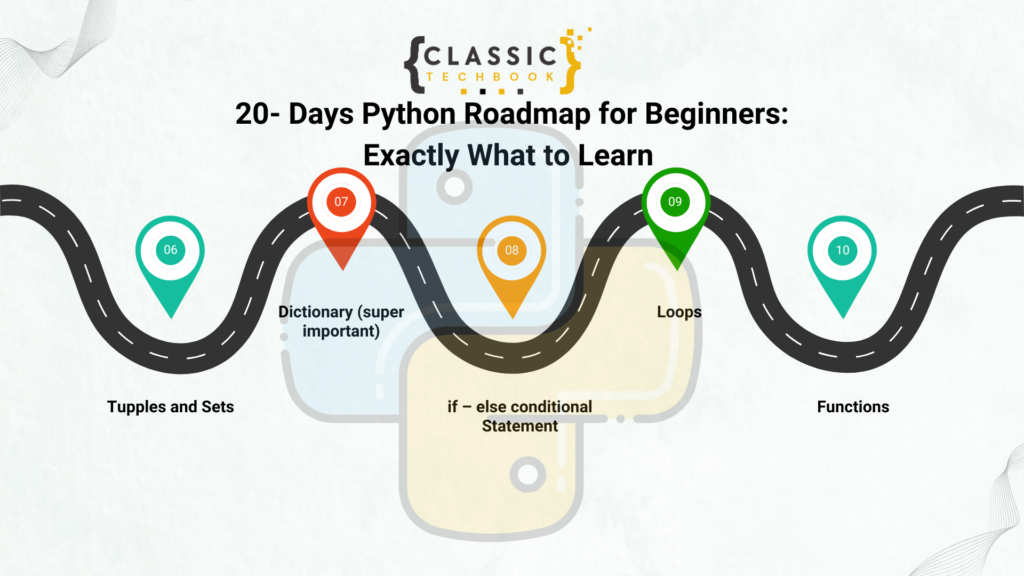
Day 6: tupples and sets
Tupples: tupples are the similar as list but tupple cannot be changed once created that’s why tupple are immutable. Tupples are used in such as days in a week, months in a year etc. things which fixed.
Sets: Sets stores the values but does not allow duplicates in it.
Where are sets used?
we used sets where we want to remove duplicate values, unique IDs, Unique email IDs etc.
Day 7: dictionary (super important)
Dictionary: it stores the data in pairs of Key- Value. We access value using that key. Example: Phone Contacts (Name – Number) etc.
Importance of Dictionary: Dictionary makes data easy to understand and easy to access
Where we use dictionaries: we use dictionaries in user profiles, APIs, JSON data databases etc.
Day 8: if – else conditional Statement
Conditional Statement: we use conditional statements to run a statement as much as conditions is true. Example: If age is 18 or more than you can vote.
There are two types of conditional statements.
Where is if-else used?
- Login systems
- Eligibility checks
- Payment success/failure
- Game logic
Day 9: Loops
Loops are used to repeat the same operation again and again there are two types of loops for loop and while loops. We needed loops when we have to do same task multiple times. And there
If you want t learn python basic commands click here.
Day 10: functions
Functions are the part of the program which we want to use again in the program it will reduce the repetition of that code and help to reuse that code with writing it again.
There are some terms in functions
- parameters, return value
- default arguments
- lambda function
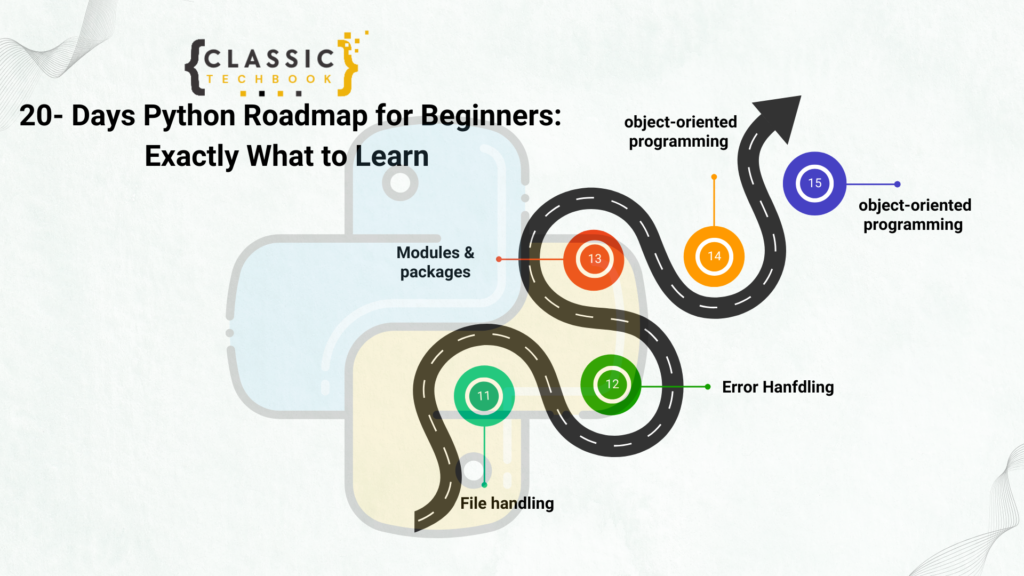
Day 11: file handling
it means the handling of data and reads a file in python program using any library. It helps you to read and write file in program.We use file handling in saving user data, logs, reports and csv files.
Day 12: Error handling
Error handling prevent the program from getting crashed when you made something wrong in the program.
There are some common errors in python:
- Syntax Error
- Exceptions
- Handling Exceptions
- Raising Exceptions
- Exception Chaining
- User-defined Exceptions
- Defining Clean-up Actions
- Predefined Clean-up Action
Day 13: Modules & packages
Modules are ready made tool written by others and you are free to use that tool. Modules save the times because you don’t have to write code from scratch.
Modules are used in the math calculation, date and time, internet requests, data handling etc.
Day 14 & 15: object-oriented programming part 1
What is OOP?
When we are writing programs using real world objects, OOP is the way to write that code.
Why OOP is important?
OOP is used in the large applications. When we use OOP it makes the code organized and easy to manage big projects.
Where is OOP used?
- Software applications
- Games
- Websites
- Mobile apps
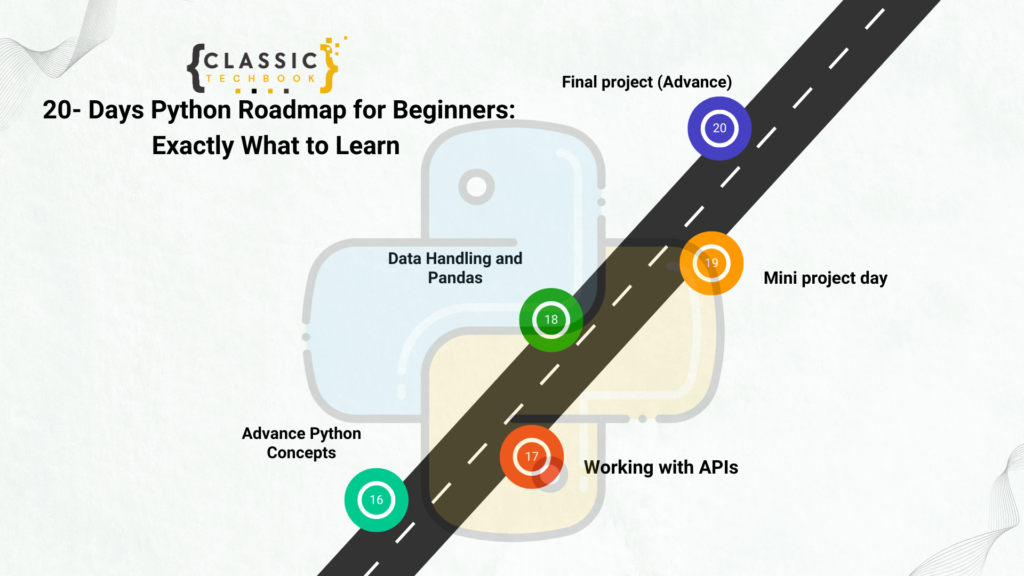
Day 16: Advance Python Concepts
Advance Python concepts are help to write code in shorter form and also makes your programs faster than usual.
Where are they used?
- Professional Projects
- Optimizations of performance
- Automation at advance level
Day 17: working with APIs
what is API?
API will help you and allows one application to talk to another applications. Example: weather app, payment apps etc.
Where are APIs used?
- Mobile apps
- Websites
- Data services, etc;
Day 18: Data Handling and Pandas
Pandas: It is a library used for working with tables and handling large data in the form table.
Where is Pandas Used?
Pandas are used in the excel operations, data analysis, report, Machine learning and model training etc.
Day 19: Mini project day
On 19th day you have to work on small real-world applications and do practice which will build you confidence.
Example: To do app, contact book, quiz game etc.
A small projects or mini project will help you to learn the practical learning of Python programming and improves your ability of problem solving.
Day 20: Final project (Advance)
At final you have make a major project where you will use your entire learning you have learn in this python roadmap and also learn some new things while making the project. It will also make your CV.
Choose any one:
- Python automation
- Web scraping
- Flask mini app
- calculator
Share this 20 days python roadmap to you loved ones who wants to learn python.
Follow the python official documentation click here
Bonus:
- Practice daily on hacker rank / code chef / leetcode (easy)
- Build 3 4 small projects
- Learn git + git hub basics
FAQs – 20 Days Python Roadmap for Beginners
Is Python good for beginners?
Yes, Python is one of the easiest programming languages for beginners.
Can I learn Python in 20 days?
Yes, if you follow this 20 Days Python Roadmap for Beginners and practice daily.
Do I need maths to learn Python?
Only basic maths is enough for beginners.
What should I do after learning Python?
You can learn web development, data science, or automation


Pingback: Ultimate Data Analyst Interview Questions – SQL & Power BI (2026) - Classic Tech Book
Pingback: 7 Python Data Types You Must Master to Become a Real Programmer - Classic Tech Book